

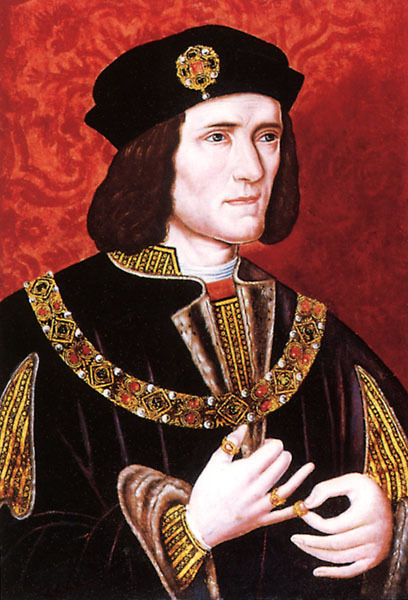
In 2012, archaeologists uncovered the final, humble resting place of England’s King Richard III beneath a parking lot in Leicester, where the long-lost Greyfriars church once stood. It was a remarkable end to a centuries-long mystery, and a reminder that history has a way of burying both bones and reputations. Few reputations have suffered more than Richard’s. Thanks largely to Shakespeare, he is remembered as the twisted, ambitious villain of English history: physically deformed, morally bankrupt, and willing to murder his way to the throne. Hardly a man anyone would associate with love, let alone tenderness. Historians continue to debate how much of that portrait was Tudor propaganda, but Shakespeare’s Richard has eclipsed the man who actually lived.
And yet…
The very same playwright who made Richard one of literature’s greatest villains also gave him one of its most beautiful and tender marriage proposals.
GLOUCESTER
Vouchsafe to wear this ring.
LADY ANNE
To take is not to give.
GLOUCESTER
Look, how this ring encompasseth thy finger.
Even so thy breast encloseth my poor heart;
Wear both of them, for both of them are thine.
And if thy poor devoted suppliant may
But beg one favour at thy gracious hand,
Thou dost confirm his happiness for ever.
I have loved those lines ever since I first read them in college.
They are elegant, intimate, and unexpectedly vulnerable. The image of the ring encircling Anne’s finger just as she has encircled his heart is one of Shakespeare’s loveliest metaphors. For a brief moment, Richard lays aside his schemes and speaks with a tenderness that feels utterly sincere.
Or does it?
That’s what fascinates me.
By this point in the play, Shakespeare has already shown us exactly who Richard is… or at least who he wants us to believe Richard is. We know he is manipulative. We know he is ruthless. We know he can shape words into weapons as easily as anyone who ever stepped onto the stage.
So why do these lines still move me?
Perhaps because Shakespeare himself cannot resist giving his villains moments of startling humanity. He understood that evil wrapped in eloquence is infinitely more compelling than evil alone. Richard doesn’t become sympathetic because we forget his crimes. He becomes unforgettable because, despite knowing what he is capable of, we catch ourselves wanting to believe him.
That may be Shakespeare’s greatest trick.
As readers, we know we’re being manipulated. Richard is manipulating Anne. Shakespeare is manipulating us. And somehow, for the space of a few lines, we’re willing accomplices.
It’s a testament not to Richard’s goodness but to Shakespeare’s genius.
The rediscovery of Richard III’s remains encouraged many people to look beyond the Tudor caricature and reconsider the historical king. Whether history ultimately redeems him or not, I suspect Shakespeare’s Richard will always remain the more famous of the two.
And every time I read this scene, I find myself admiring the playwright who could make me momentarily fall for the words of the man he had spent an entire play teaching me to distrust.
As a writer, I’m fascinated by the ways authors manipulate our sympathies.
In Shakespeare’s hands, we know Richard is dangerous long before he slips a ring onto Anne’s finger. Yet somehow we’re tempted to believe that, just this once, he means every word.
When I wrote The Moonlight Market, I found myself exploring the opposite challenge. Instead of asking readers to distrust a villain they couldn’t help but admire, I asked them to trust a man who was quietly leading the person he loved toward betrayal. Sanderson spends much of the novel earning Cory’s confidence through small, tender gestures, all while intending to deliver him to the Weaver of Dreams to settle an impossible debt. It’s the mirror image of Richard’s courtship, and it taught me an even greater appreciation for Shakespeare’s sleight of hand.
Whether we’re reading or writing, the most memorable characters are often the ones who make us question our own judgment.